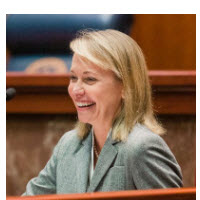
Since graduating first in his class at Baylor Law School, Justice David J. Schenck has built a reputation of integrity and independence throughout his expansive three-decade career as a tough but fair legal mind who calls them like he sees them, free of bias or outside influence. He led the Texas State Commission on Judicial Conduct, the Constitutional body that oversees the behavior of all judges in Texas. He is an ethical, principled stalwart who is applauded for standing up against cronyism and any form of the “pay for play” politics that are far too common today. He has also been honored with the State Bar’s highest award for pro bono legal service
Appointed to the Fifth District Court of Appeals by Governor Rick Perry in 2015, Justice Schenck was elected to a full term in the largest appellate district in the state in 2016 demonstrating his ability to succeed in a tough election and ro lead major battles over upholding the Constitution while on the bench (google “Justice Schenck does not pull punches”). Prior to that, his career spanned the full scope of legal experience, from private practice to public service at the highest levels of state government.
Known and respected for both his legal expertise and his leadership, Judge Schenck oversaw key practices ranging from litigation to appeals for private law firms. In 2010, he joined the Office of Attorney General Greg Abbott, serving as Deputy Attorney General for Legal Counsel — functioning as chief legal counsel to the AG and leading the team defending the state’s redistricting plans until 2012.
Justice Schenck has received the highest-possible “AV” rating from Martindale Hubbell, reserved for attorneys who have reached the highest levels of professional excellence, skill, and integrity. He has previously served on the adjunct faculty of the Southern Methodist University School of Law and the University of North Texas College of Law. He is board certified in appellate law (civil), a member of the American Law Institute, and a Master of the Bench of the Patrick Higginbotham Inn of Court, and repeatedly included in various “best’ and “Super lawyers”’ lists. He served also as Chairman of the Texas State Commission on Judicial Conduct, the body responsible for oversight of the State Judiciary. Over the years, he has made his positions on judicial integrity, competence and the need for reforms to promote public confidence well known including his 2022 race for the Texas Supreme
His track record leaves no doubt about his commitment to the Constitution, the rule of law, and the right of all Texans to an honest, competent, and impartial judiciary. As the TLR Advocate recently summarized, he “is a skilled and competent judge with over 25 years in private practice and government service”. “Republican Justice David Schenck is arguably the most qualified Justice who’s ever sat on the 5th Court of Appeals” (Texas Lawyer, 2015).
‘Justice Schenck is a Christian, a member of the Highland Park Methodist Church, husband and father of two children who attend Dallas public schools.
For more information, please read about Justice Schenck’s Campaign Message, view Justice Schenck on The Jeff Crilley Show, and review selected Recent Media Coverage, including “The verdict is in. This judge rules” by Dave Lieber for Dallas Morning News.
Issues:
The rules governing all Texas courts and judges are made by the state’s two highest courts, the Supreme Court governing civil and the Court of Criminal Appeals governing criminal matters. In big ways and small those courts must implement ethics and rules changes to reassure public confidence in the fairness and competence of its courts, the fairness of its elections, and the fidelity of state government to the Constitution.
Texas Deserve Transparently Fair Courts
The judiciary’s authority depends entirely on the public’s confidence in the integrity and impartiality of those who issue its decisions, and – in Texas and elsewhere — that confidence has been shaken. Over my career, spanning almost 30 years, I have repeatedly fought – winning, in many instances – to maintain judicial systems free from outside influence.
I spent eight years as a justice on the Dallas Court of Appeals, where I adhered to my oath and the constitutional command for a judiciary that is fair and impartial both in reality and in appearance.
Texas, however, has traditionally struggled with this.
A 2001 study, “Pay to Play: How Big Money Buys Access to the Texas Supreme Court,” examined petitions filed in the Texas Supreme Court and compared them to the contributions made by the law firms who filed them. Those who did not contribute were heard 9% of the time, and firms giving more than $100,000 did disproportionately better. Even in innocent situations it doesn’t look good, and worse, it erodes confidence in a system that has to be above reproach.
The U.S. Supreme Court took note of the problem. In 2009, it held that the federal constitution forbids judges to sit where there is an objective appearance of a “likelihood” of bias, urging states to consider stricter recusal standards. In 2015, it adopted the position urged by myself and other attorneys in the case Dimick v. Republican Party of Minnesota, saying that states can regulate judicial fundraising to promote public confidence in impartiality. And, in 2016, it held that due process concerns arising from a single judge were shared across all judges serving on an appellate court.
Other states responded to this by enacting new ethics rules.
Texas, meanwhile, actually made things worse, removing an established barrier preventing judges from coordinating their campaign activities. As a result, litigants appearing in multi-member appellate courts are left to wonder whether a member might be coordinating the collective effort or directing other members on the interests at stake.
Perhaps unsurprisingly, things haven’t improved. Another study of cases through 2016 again showed a direct correlation between contributions and outcomes, with the same small handful of law firms making the massive donations, along with several more added to the list.
This, combined with the prospect of dark money and PAC contributions, leaves the court and all of the judges on it needlessly open to the awful suggestion that outcomes are driven in response to massive contributions from third parties.
Surely no one person or firm is to blame for this problem or the resulting crisis of confidence, and the overwhelming bulk of Texas business and citizens will come before the court not participating in or perhaps even aware of this problem. However, accountability and action are sorely lacking and long overdue.
That’s why, if elected, I will advocate for an efficient system of Justice, including ethics rules that are currently lacking:
- forbidding judges from directly contacting parties or lawyers to parties with pending cases to request campaign contributions.
- mandating recusal of a judge from sitting on any case (at the request of a party) where he or she, or any colleague they may have coordinated with regarding any campaign activity, has accepted excessive contributions (whether by themselves, by direct expenditures or through PACs) or other financial assistance during a case or in the four years preceding the filing.
- Prohibiting law firms and employees of law firms from giving amounts collectively in excess of what an individual might give in a cycle.
- Requiring lawyers and parties represented by them to disclose to the other side any amounts given to a member of the court within the last four years, whether directly or indirectly and immediately when the contribution is made in a pending case.
- Forbidding judges or justices from acting as bundlers or coordinating financial or other campaign activities that might be a basis for one judge or justice to influence another’s decision.
- Requiring that parties have access to the Personal Financial Statements judges are required to annually file to evaluate possible relations to their opponent, rather than filing Public Information Act requests.
These are basic and important steps that will help to answer allegations of “pay for play” and go a long way toward restoring the public’s trust in our judiciary here in Texas. It’s also why I have made it a centerpiece of my campaign as I run for the Presiding Judge seat on the Texas Court of Criminal Appeals.
Texas Needs Criminal Courts That Are Fair and That Work
The Court of Criminal Appeals is the supreme authority over the state’s criminal jurisprudence. If Texans are to have any confidence in the efficient and fair operation of their criminal laws they can look only to that Court, it’s presiding judge, and the 8 remaining members of that court. But, the Court‘s judges down fewer opinions and did so more slowly than virtually any other appellate court with criminal jurisdiction of like size, state or federal. And when the Court does actually hear and decide cases, practitioners and lower court judges alike are often left uncertain of the state of the law, as the Court’s decisions often leave readers to wonder about the court’s rationale and process.
The Court too often decides simply not to hear matters posing basic, recurring questions of law. And yet it also sometimes decides to accept review and grant relief on issues not even raised by the defendant—without allowing the state notice of the issue or an opportunity to be heard. Other times the Court will accept review and decide the case without allowing either side to argue at all. And, in many other cases, the Court will accept review and then go into hibernation while the parties, who are often incarcerated under convictions the lower courts may have already declared to be unlawful, simply wait for the cases to be resolved some day. There is simply no excuse for a case filed with the Court in 2019 to be so delayed as to be sitting, parked and undecided in 2024.
Since 1981, Texas criminal cases have all been directed to intermediate appellate courts before the parties might petition the Court of Criminal Appeals for discretionary review. Judges on those lower courts have all studied those cases and developed a depth of expertise in the area The rules of appellate procedure should direct any of those justices hearing a case to certify the presence of any issue of potential merit or of importance to the state’s criminal jurisprudence, whether or not the issue warrants relief in that case. The presence of such a certification should signal a need for heightened and expedited scrutiny in the Court of Criminal Appeals separate and apart from the existing petition process.
Meanwhile, the Court should be hearing considerably more cases, perhaps twice as many as at present, and deciding them in the same time frame as its colleagues in the local federal appellate courts—that’s months not years. And, every case important enough to warrant review should be argued—or the lawyers at least offered the opportunity to argue—by remote electronic means if necessary to accommodate health or travel concerns.
Source: https://www.schenckfortexas.com/